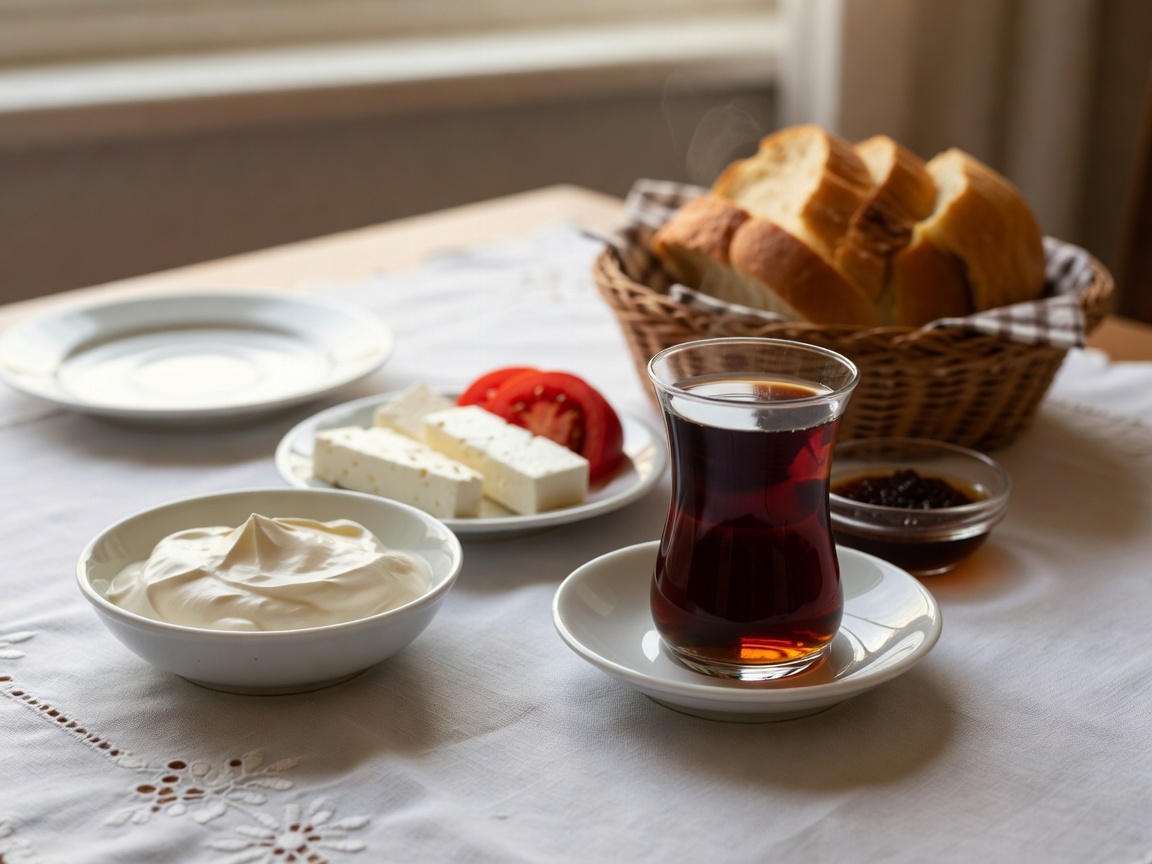
The Rejection of the Solitary Breakfast
In most industrialized Western societies, breakfast has devolved into an atomized, grab-and-go transaction: a cardboard cup of espresso sipped in transit or a protein bar eaten before a laptop screen. In modern Turkey, however, such behavior is viewed not merely as unappetizing, but as a minor social tragedy.
"To eat Kahvaltı alone is to admit that you have no neighbors, no family, and no time for humanity." — Popular Anatolian Proverb.
The Turkish morning spread—Kahvaltı—is structurally engineered to be impossible for one person to consume. With anywhere from 15 to 35 separate dishes covering the cloth from edge to edge, the feast is inherently a social compact. It requires at least two people, preferably six or eight, lingering over two to three hours of lively discourse.
Ottoman Palace Legacies and Meze Architecture
To understand the sheer abundance of Kahvaltı, one must examine the kitchens of Topkapı Palace during the 16th and 17th centuries. The Ottoman imperial court functioned on a culinary diplomacy of regional representation: honey from the Black Sea mountains, sheep cheeses from Thrace, cured olives from the Aegean coast, and butter from the pastures of Trabzon.
When the Sultan broke his fast, the table was designed to showcase the geographical diversity of the empire on tiny porcelain plates. In the 20th century, this royal banquet model was democratized into the family home and the vibrant weekend Kahvaltı salonu culture of Istanbul's Beşiktaş and Moda neighborhoods.
The Thermodynamics of the Çaydanlık (Double Teapot)
The social rhythm of Kahvaltı is regulated by tea. Unlike coffee, which is served in small cups and signals the formal conclusion of the gathering, Turkish black tea (çay) brewed in a two-tiered kettle (çaydanlık) is continuously replenished in clear, waist-curved tulip glasses (ince belli).
🫖 The Visual Contract of the Glass
The thin waist of the tulip glass serves a social purpose: it traps heat in the lower bulb while keeping the rim cool to the lips, allowing the diner to hold the glass indefinitely while talking. Because the glass is transparent, the host can instantly spot when an empty glass requires a fresh pour without asking, ensuring no conversational interruption.
Contrast as Culinary Dialogue
The flavor profile of Kahvaltı mirrors its social purpose: it is a perpetual negotiation between opposites. Salty sheep cheese (Beyaz Peynir) is balanced immediately by buffalo clotted cream drowning in honeycomb (Bal & Kaymak); the fiery spice of garlic beef sucuk is cooled by crisp slices of Persian cucumber and fresh spearmint leaves.
In an era characterized by digital alienation, the Turkish breakfast table stands as one of the world's most resilient physical forums for human bonding, storytelling, and generational connection.